

Returns management for eCommerce: The Complete Guide
eCommerce returns management is the end-to-end process of handling products that customers send back – from the moment a customer requests a return, through collection or drop-off, transit, inspection and restocking or disposal, to the refund or exchange and the data the business captures along the way. Done well, it protects margin, keeps customers loyal and turns a cost centre into a source of insight. Done badly, it quietly drains profit and pushes shoppers towards competitors.
Returns are not a fringe problem. For online retail they are structural, and for some categories they are enormous – online fashion routinely sees return rates several times higher than physical retail. Yet many businesses still treat returns as an operational afterthought bolted on to the end of the delivery process. This guide covers what returns management involves, what a return genuinely costs, why returns are as much a delivery problem as a warehouse one, how to reduce the return rate without harming the customer experience and how international returns change the picture.
Key Takeaways
Returns management spans the whole reverse journey: request, transit, inspection, restock or disposal, refund and the reason-code data captured throughout
A return costs far more than the refund: return shipping, processing, inspection, restocking, markdowns and lost margin all stack on top
Returns are a delivery problem, not only a warehouse problem: the carrier mix, returns routes and tracking determine cost and customer experience as much as the warehouse does
The return rate can be reduced from two directions: before the parcel ships (accurate product information, sizing, fit) and after it arrives (a clear returns route and reason-code capture)
International returns are a complexity multiplier: customs, VAT recovery and Returned Goods Relief turn a simple refund into a cross-border operation
GFS manages returns through GFS Global Returns Pro and its managed returns service, run across the same carrier network as outbound delivery
What is eCommerce Returns Management?
Returns management – also called reverse logistics – is everything that happens after a customer decides to send an item back. A complete process covers six stages:

1. The request
The customer initiates a return, ideally through a self-service returns portal that captures why the item is being returned

2. The route
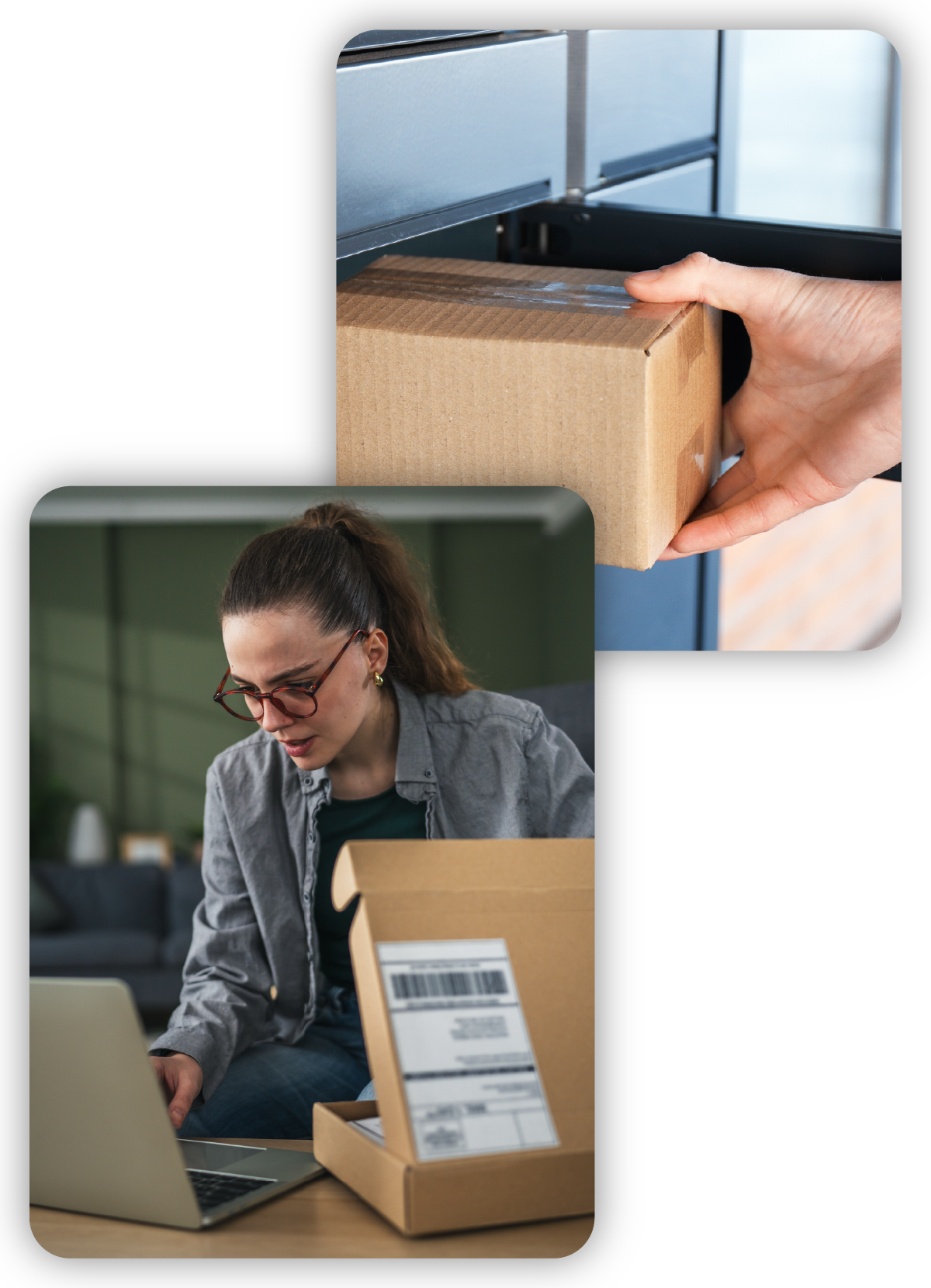
The customer is given a way to return the parcel, whether a printed label, a label-free QR code at a drop-off point, a locker or a collection
3. Transit
The parcel travels back through a carrier network, tracked so both the retailer and the customer can see its progress

4. Inspection and grading
The returned item is checked and graded for resale, refurbishment or disposal

5. Resolution
The customer receives a refund, exchange or store credit, promptly enough to protect the relationship

6. Data capture
Reason codes and patterns are recorded, so the business learns which products, sizes and descriptions drive returns
The last stage is the one most often skipped, and the most valuable. A returns process that only moves parcels is a cost. A returns process that also captures why items come back is a feedback loop that can be used to fix product descriptions, sizing guidance and supplier quality.
The True Cost of a Return
The headline figure – the refund – is the smallest part of what a return costs. The hidden costs sit underneath it:
Return shipping: the cost of getting the item back, whether the retailer or the customer pays for it
Processing and inspection: the labour to receive, open, check and grade every returned item
Restocking or write-down: items that cannot go straight back to full-price stock – opened, used, out of season – are restocked at a cost or written down in value
Markdown and disposal: goods that cannot be resold at full price are discounted, liquidated or disposed of, with the environmental cost that disposal carries
Customer service: returns generate contacts, and contacts cost time
Lost margin and lost sale: a returned item ties up stock, cash and shelf space, and the original margin is erased even before the cost of handling the return is counted
Put together, the fully loaded cost of a return frequently runs to a significant share of the item’s value – and for low-margin categories it can wipe out the profit on the sale entirely. This is why returns management is a margin issue, not just a logistics one.
Why Returns are a Delivery Problem, Not Just a Warehouse Problem
It is tempting to treat returns as a warehouse function: parcels arrive, get checked and get processed. But most of what determines the cost and quality of a return happens before the item reaches the warehouse – in the delivery and carrier layer.
The returns route shapes the customer experience: whether a customer gets a printed label, a label-free drop-off, a locker or a doorstep collection is a carrier-and-network decision. The easier and more local the route, the more likely a shopper is to buy again
Carrier choice shapes the cost: returns volumes are uneven and often bulky in aggregate. Routing returns across the right carriers, rather than defaulting to one, controls the cost of getting goods back
Tracking shapes the contacts: a return the customer can track stops a stream of “have you got it yet?” messages, and it lets the retailer trigger the refund on receipt rather than guesswork
International returns are entirely a delivery-and-customs problem: once a return crosses a border, the warehouse is the least of it – customs, VAT recovery and reverse declarations dominate (covered below)
This is the core of why returns belong inside a managed delivery strategy rather than beside one. The same carrier network, routing logic and tracking that move parcels out should move them back. GFS handles outbound and returns through the same Enterprise Carrier Management platform for exactly this reason.
How to Reduce Your eCommerce Return Rate
The return rate can be attacked from two directions: stopping the returns that should never have happened, and handling the rest well enough to keep the customer.
Before the parcel ships – reduce avoidable returns:
- Accurate, detailed product information: a large share of returns come from a gap between what the customer expected and what arrived. Better photography, dimensions, materials and honest descriptions close that gap
- Sizing and fit guidance: in fashion and footwear, sizing is the single biggest return driver. Size guides, fit notes and review-based sizing feedback cut “wrong size” returns directly
- Manage bracketing and serial returners: some customers buy multiple sizes or variants intending to return most, and a small group returns habitually. Reason-code data makes these patterns visible so they can be managed through policy
After the parcel arrives – handle the rest well:
- A self-service returns portal: letting customers start a return themselves, with reason codes captured at the point of request, reduces customer-service load and feeds the data loop
- Paperless, label-free returns: QR-code drop-off removes friction for the customer and printing for the retailer, and widens the network of convenient return points
- Reason-code capture and analysis: knowing why items come back is what turns returns from a recurring cost into a list of fixable problems. Fashion and footwear see the highest return rates of any category, so these levers matter most there.
Domestic vs International Returns
A domestic return is a logistics task. An international return is a customs task wearing a logistics coat. The differences are significant enough that they should be planned separately.
| Factor | Domestic returns | International returns |
|---|---|---|
| Main challenge | Cost and convenience of getting the item back | Customs clearance, VAT recovery and documentation |
| Transit | Carrier collection or drop-off within one country | Cross-border carriage with reverse customs declarations |
| Tax and duty | VAT handled domestically | VAT and duty recovery via Returned Goods Relief and IOSS mechanics |
| Documentation | Minimal | Reverse declarations, commodity codes, proof of original export |
| Cost driver | Return shipping and processing | Customs, duty/VAT recovery and carrier-plus-clearance cost |
| Customer experience | Local drop-off or collection | Longer, harder to track without the right partner |
Two mechanisms matter most for UK retailers handling returns from abroad. Returned Goods Relief (RGR) allows goods that were exported and are being returned to come back without paying duty and import VAT again, provided the conditions and timelines are met. IOSS and reverse declarations govern how VAT is accounted for on cross-border parcels, including those coming back. Getting either wrong means paying tax twice or holding returns at the border.
The 2026 EU customs reforms add to this. With the removal of the low-value threshold and new per-item charges, the cost and paperwork around cross-border parcels – including returns – have risen, which makes a managed approach to international returns more valuable than before. GFS supports cross-border movement, including the customs and VAT mechanics that returns depend on, through its international eCommerce services.
Turning Returns into a Retention Tool
Returns are usually framed as a cost to minimise. The more useful frame is that the returns experience is part of the buying decision. A large share of shoppers check a retailer’s returns policy before they buy, and a smooth return is one of the strongest predictors of whether a customer comes back.
That changes the goal. The aim is not simply to reduce returns at any cost but to make the returns that do happen easy, fast and trackable, so the customer leaves the experience willing to buy again. A returned parcel is an opportunity to confirm the brand is easy to deal with, to offer an exchange rather than only a refund and to keep the relationship intact. Handled this way, returns management supports customer lifetime value rather than only protecting margin.
How GFS Approaches Returns Management
GFS manages returns as part of a single delivery service, not a separate bolt-on. As a managed multi-carrier partner, GFS routes returns across the same carrier network it uses for outbound delivery, giving retailers a complete returns management service without the need to manage carriers individually.
The service is delivered through GFS Global Returns Pro, which gives customers a clear, branded returns route – including paperless options – and gives the retailer visibility over what is coming back and why. Returns sit within Enterprise Carrier Management alongside checkout delivery options, labelling and despatch, branded tracking and consolidated invoicing, so outbound and returns run through one platform, one relationship and one invoice.
For international sellers, GFS handles the customs and VAT mechanics that make cross-border returns difficult, so a return from another market is managed rather than left to the retailer to untangle. The principle is consistent with how GFS approaches the whole delivery journey: it is a one stop shop for eCommerce delivery and returns, with returns treated as a core part of the service rather than an afterthought.
Frequently Asked Questions
Customs clearance, VAT and duty recovery and documentation. Mechanisms such as Returned Goods Relief and IOSS govern whether tax is recovered or paid twice, and the 2026 EU customs reforms have increased the cost and paperwork around cross-border parcels, including returns.